Contents
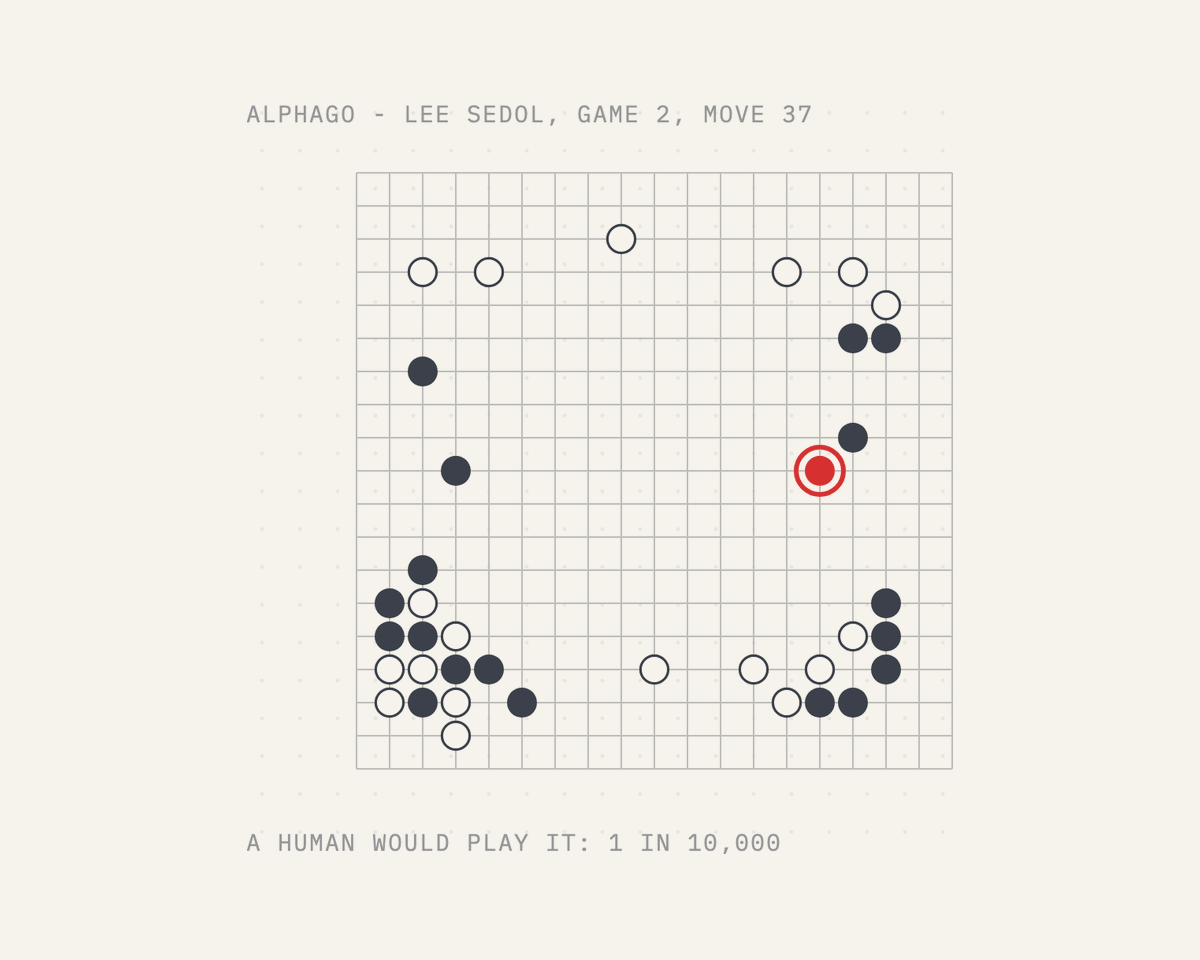
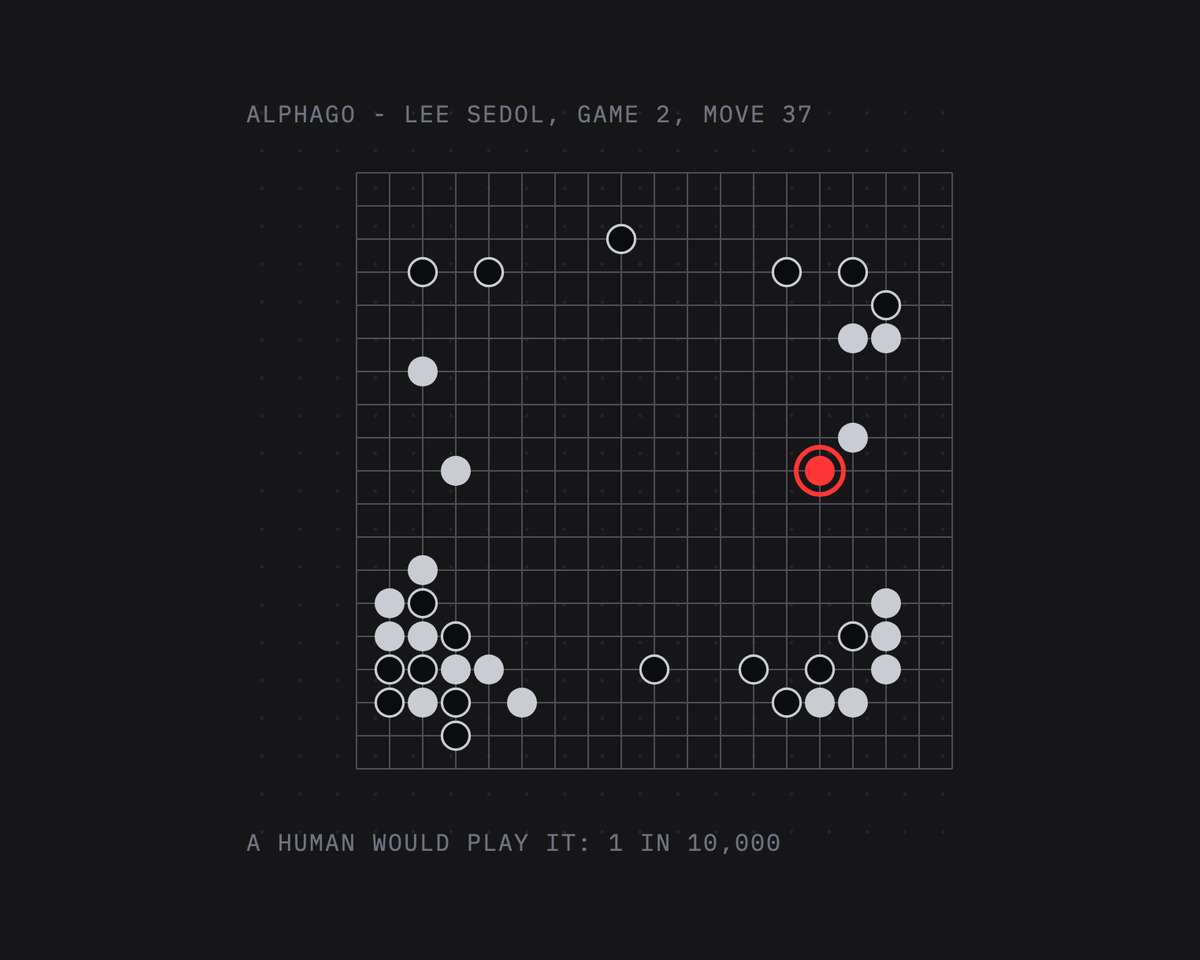
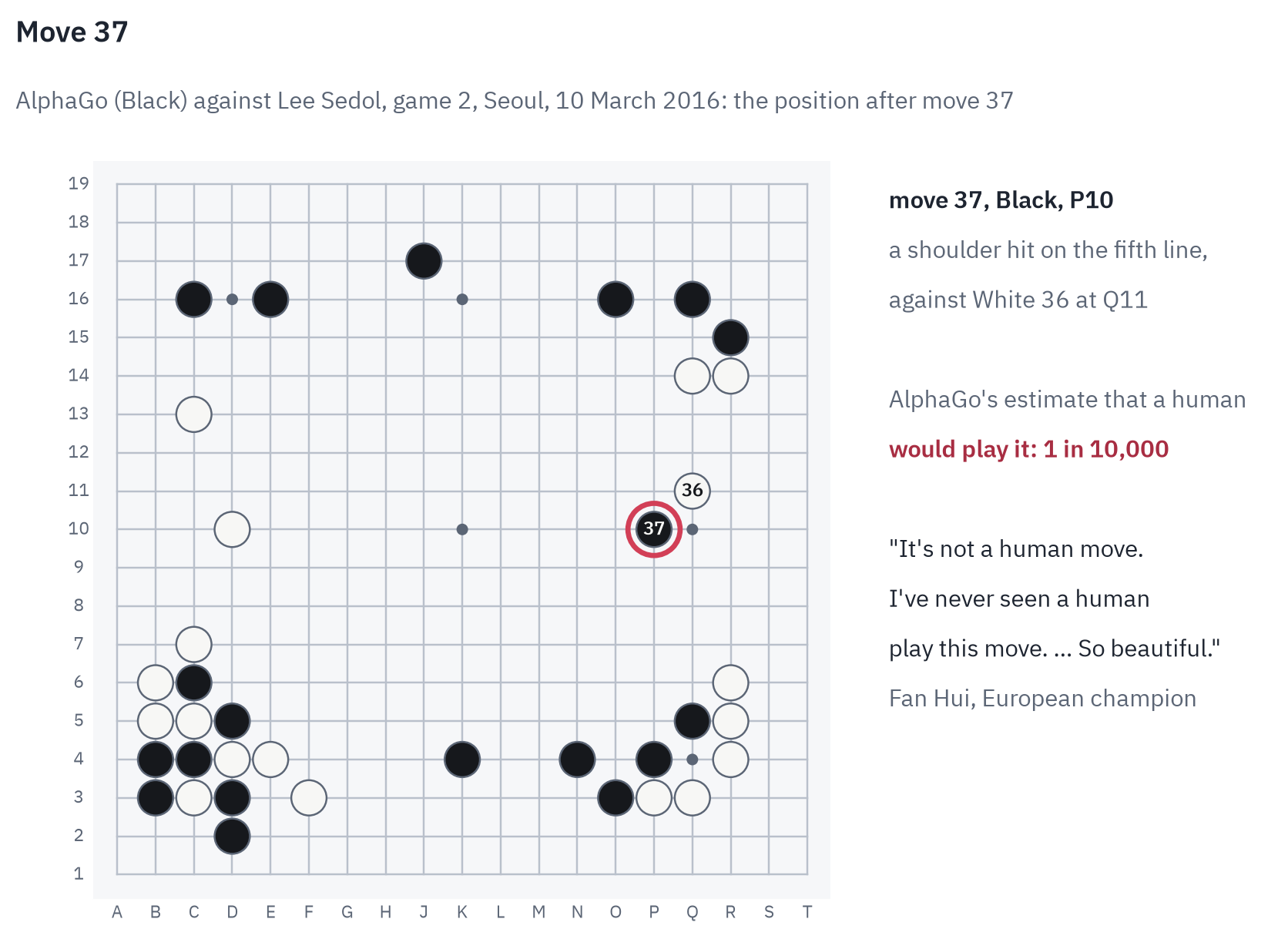
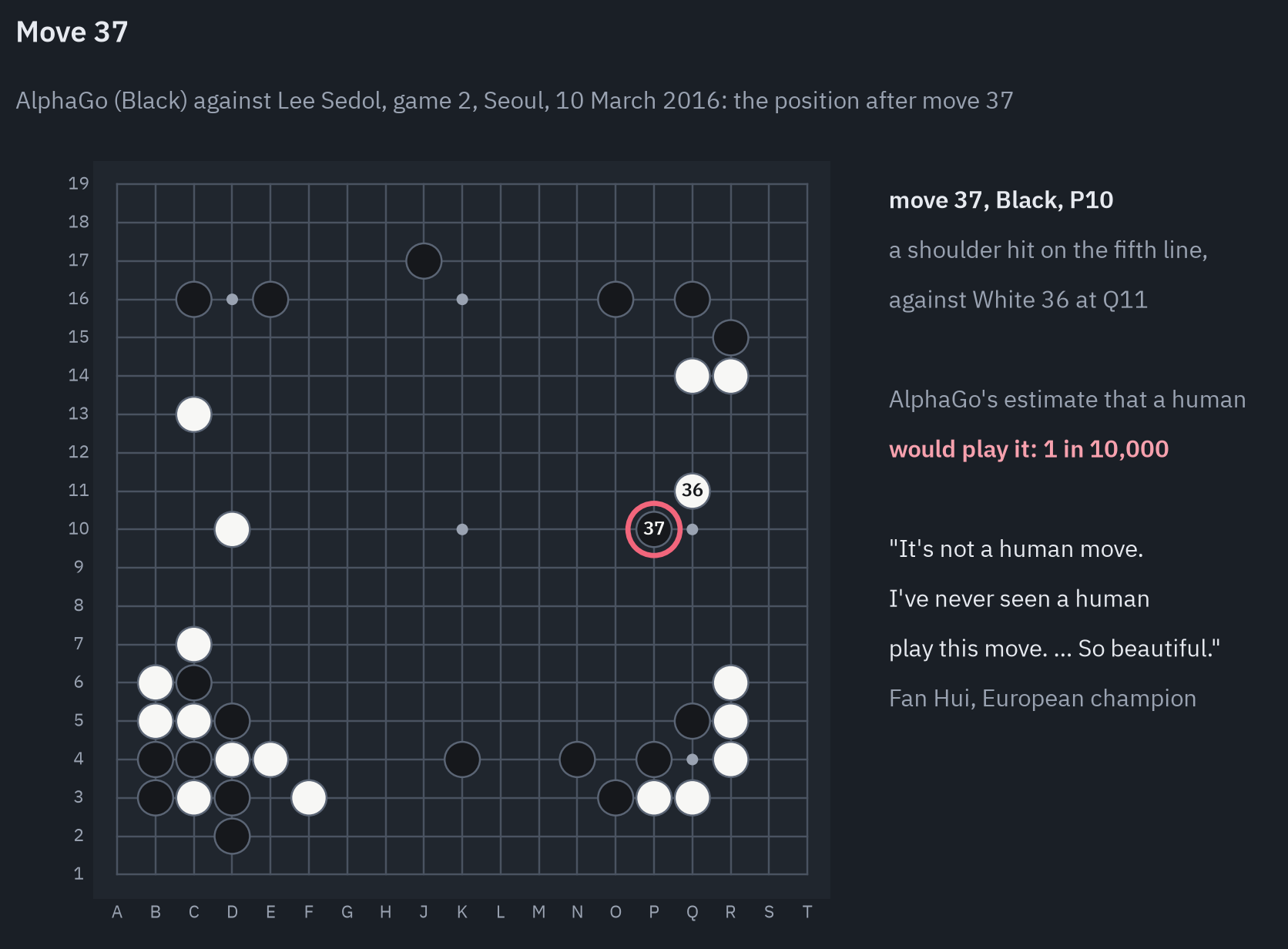
On 10 March 2016, in the second game of its match against Lee Sedol in Seoul, AlphaGo played its 37th move on the fifth line, a shoulder hit at P10 of the kind professionals learn not to play.
One of the English commentators “chuckled and said: ‘I thought it was a mistake.’” Fan Hui, the European champion, who had lost to AlphaGo a few months earlier, was watching: “It’s not a human move. I’ve never seen a human play this move. … So beautiful”[1].
Lee Sedol stood up and left the room, and spent nearly fifteen minutes on his reply. AlphaGo itself had put the chance that a human would play the move at one in ten thousand[2].
Lee said afterwards: “I thought AlphaGo was based on probability calculation and that it was merely a machine. But when I saw this move, I changed my mind. Surely, AlphaGo is creative”[3].
The view he changed his mind about is older than computers. In 1843 Ada Lovelace wrote of Babbage’s Analytical Engine[4]:
The Analytical Engine has no pretensions whatever to originate anything. It can do whatever we know how to order it to perform.
Ada Lovelace, 1843
In 1950 Alan Turing answered with a question that turns the objection on the people making it: “Who can be certain that ‘original work’ that he has done was not simply the growth of the seed planted in him by teaching…”[5].
That is the question here. Not whether a machine can create something from nothing, but whether anyone can: what a brain does when a person has a new idea, how much of it is recombining what was already there, where recombination runs out, and what the measurements of machine creativity actually show.
What counts as creative
Psychologists use a definition with two parts: an idea or a product is creative if it is both original and effective, new and fit for some purpose[6]. A random string is new and useless; a correct sum is useful and not new.
The philosopher Margaret Boden, who has written about creativity and AI since the 1980s, adds surprise: “Creativity is the ability to come up with ideas or artefacts that are new, surprising, and valuable”[7].
Boden makes two distinctions that clear up much of the argument about machines. The first is between ideas that are new to the person who has them, P-creativity, and ideas that are new to the world, “for the first time in human history”, H-creativity.
A child who works out for herself that there is no largest prime number is P-creative; Euclid, who proved it first, was H-creative. The second distinction is between three ways of being creative at all:
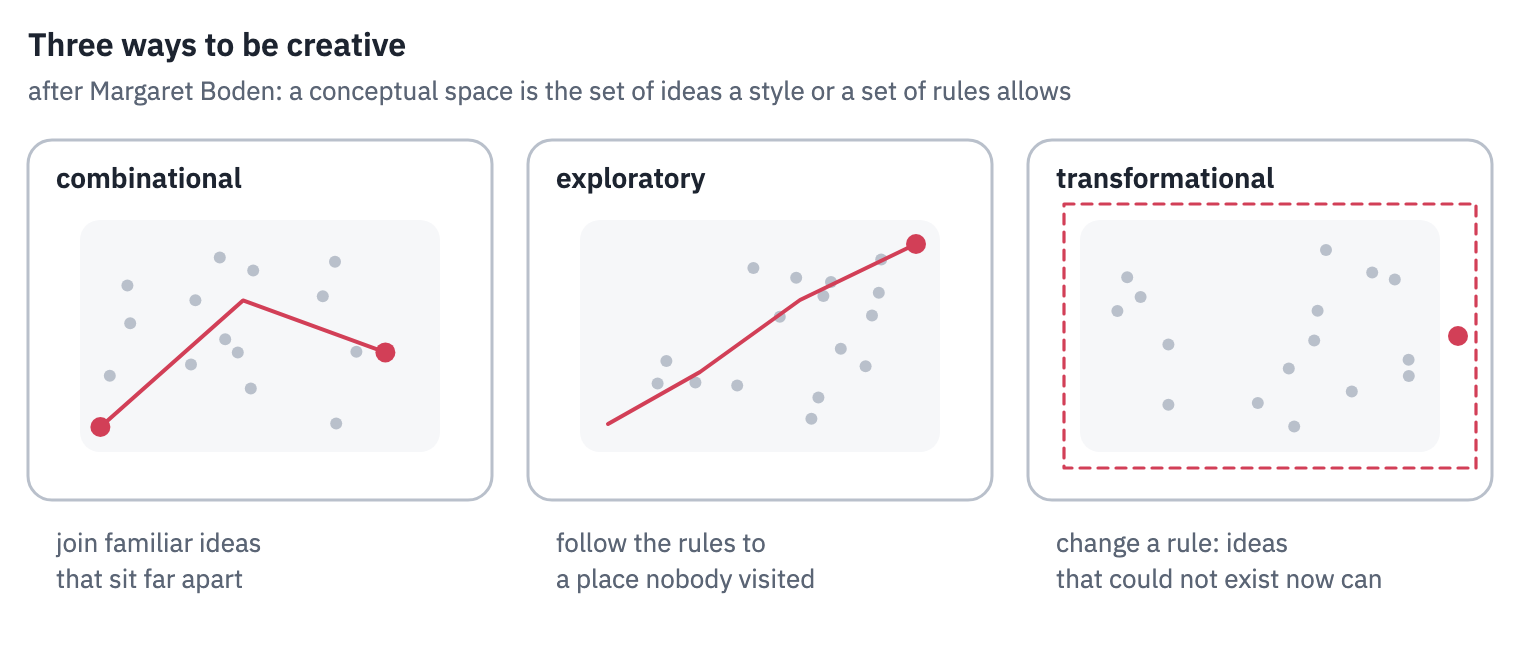
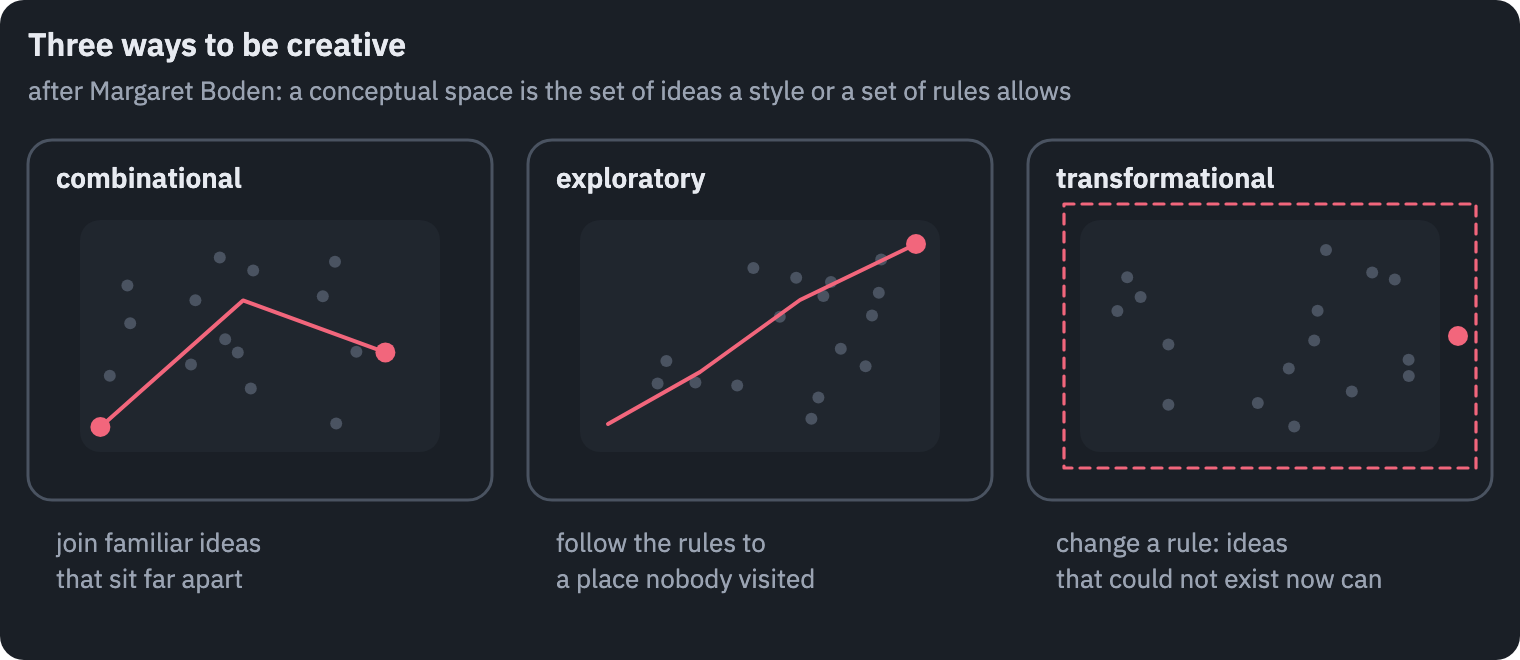
- Combinational creativity is “making unfamiliar combinations of familiar ideas”: a metaphor, a pun, a collage.
- Exploratory creativity works inside a conceptual space, the set of possibilities that a style or a set of rules allows, and reaches places in it nobody had been.
- Transformational creativity changes the space itself, so that “thoughts are now possible which previously… were literally inconceivable.”
Move 37 was exploratory. The rules of Go did not change; the move was always legal. What changed was that a player had looked, and evaluated, where generations of professionals had learned not to look.
Memory is the raw material
If people created from nothing, imagination would not depend on memory. It depends on it heavily.
Daniel Schacter and Donna Rose Addis argued in 2007 that memory is “fundamentally constructive, rather than reproductive”, and that its constructive nature is what makes imagination possible: imagining the future “requires a system that can draw on the past in a manner that flexibly extracts and recombines elements of previous experiences”[8].
The same year Demis Hassabis, then a neuroscientist and later a founder of DeepMind, tested the idea on five patients whose hippocampi, the brain’s structure for forming new memories, were damaged on both sides[9]. They were asked to imagine new scenes from short cues and describe them, and told not to recall real memories.
One patient, asked to imagine lying on a beach, said: “As for seeing I can’t really, apart from just sky. I can hear the sound of seagulls and of the sea… the only thing I can see is blue…”
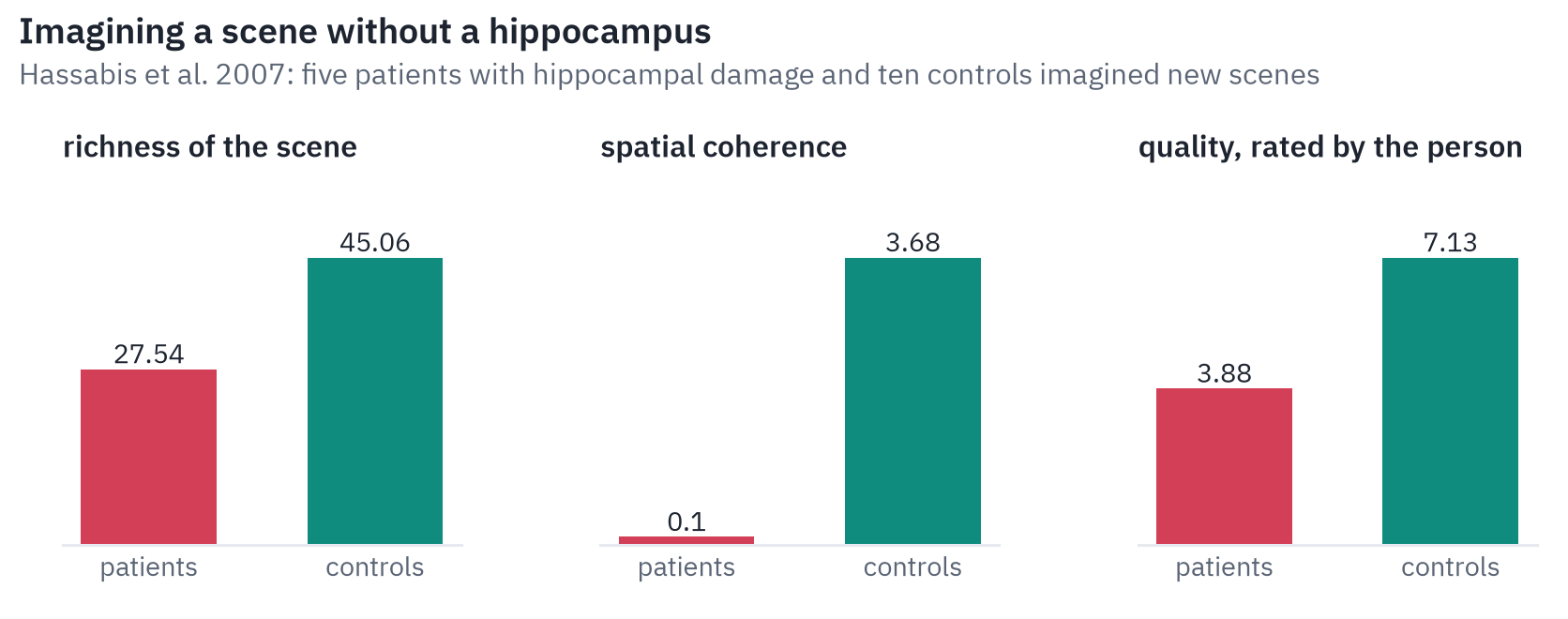
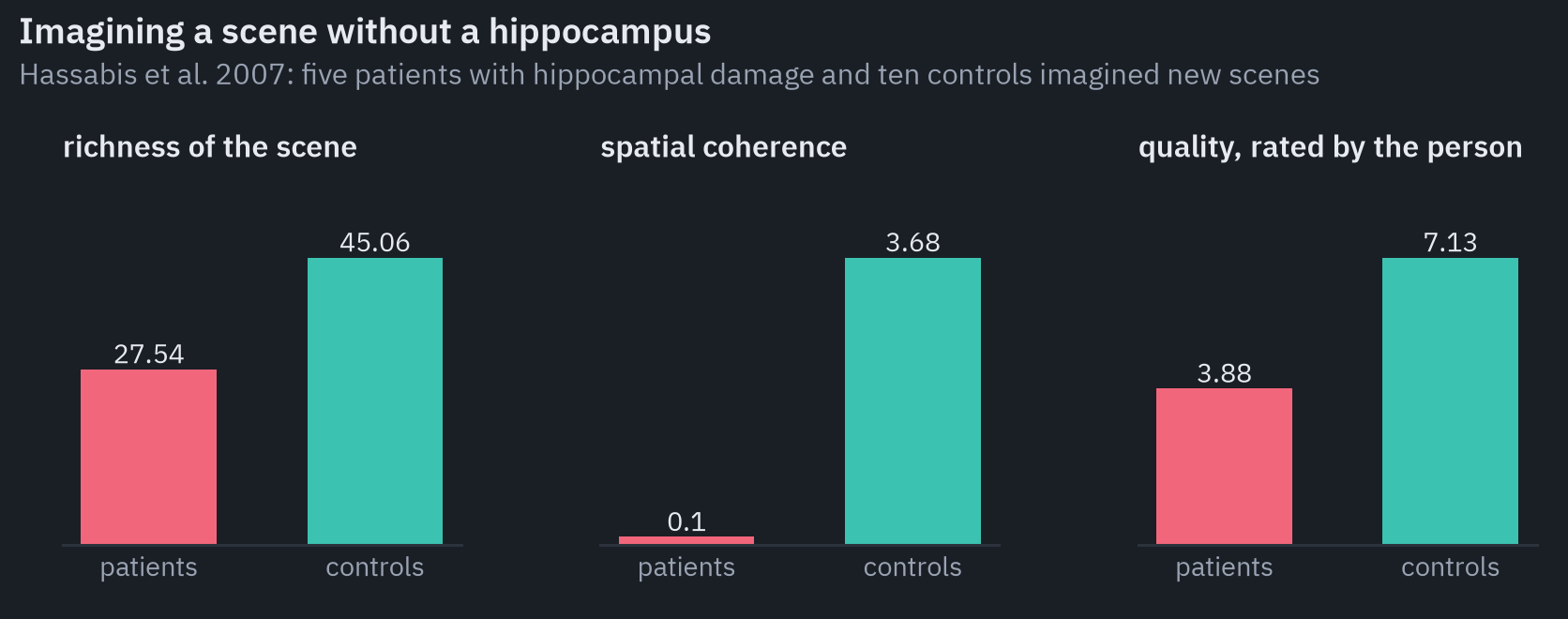
The patients’ imagined scenes were poorer and, above all, fell apart in space: “fragmented images in the absence of a holistic representation of the environmental setting.” The result has a published dispute behind it.
One of the five patients was unimpaired, and Larry Squire and colleagues found hippocampal patients who could imagine the future normally with a different method[10]; later studies with damage restricted to the hippocampus found the impairment again[11].
Key point
The weight of the evidence is that the system which stores experiences is also the one that assembles new scenes out of them.
The same system shows up when healthy people create. Melissa Ellamil and colleagues had people design book covers in a scanner, switching between generating ideas and evaluating them. “Creative generation was associated with preferential recruitment of medial temporal lobe regions”, the memory system, while evaluation recruited executive and default network regions[12].
Where recombination runs out
A good test of the recombination view is colour. Can you imagine a colour you have never seen?
John Locke told of a blind man who said he now understood scarlet: it “was like the sound of a trumpet.” Locke told the story to show that the man had not understood the word[13].
Modern experiments find something more interesting. Congenitally blind adults understand colour much as sighted people do, and they learned it from language: “blind and sighted adults share causal understanding of color, despite not always agreeing about arbitrary color facts”.
They are less likely to say that a banana is yellow, but they know what colours are for and how they relate. “Living among people who talk about color is sufficient for color understanding”[14].
Knowing about a colour is not seeing it, though, and in April 2025 five people saw a colour nobody had seen before.
A team at Berkeley built a system that aims laser microdoses at individually mapped cones in the retina and tried to stimulate only the M cones, the ones most sensitive to green. Natural light never does that: every wavelength that excites M cones also excites L cones.
The subjects described the result, which the authors named olo, as “blue-green of unprecedented saturation”[15]. To match it with ordinary light, they had to desaturate olo by adding white, “unequivocal proof that olo lies beyond the gamut.”
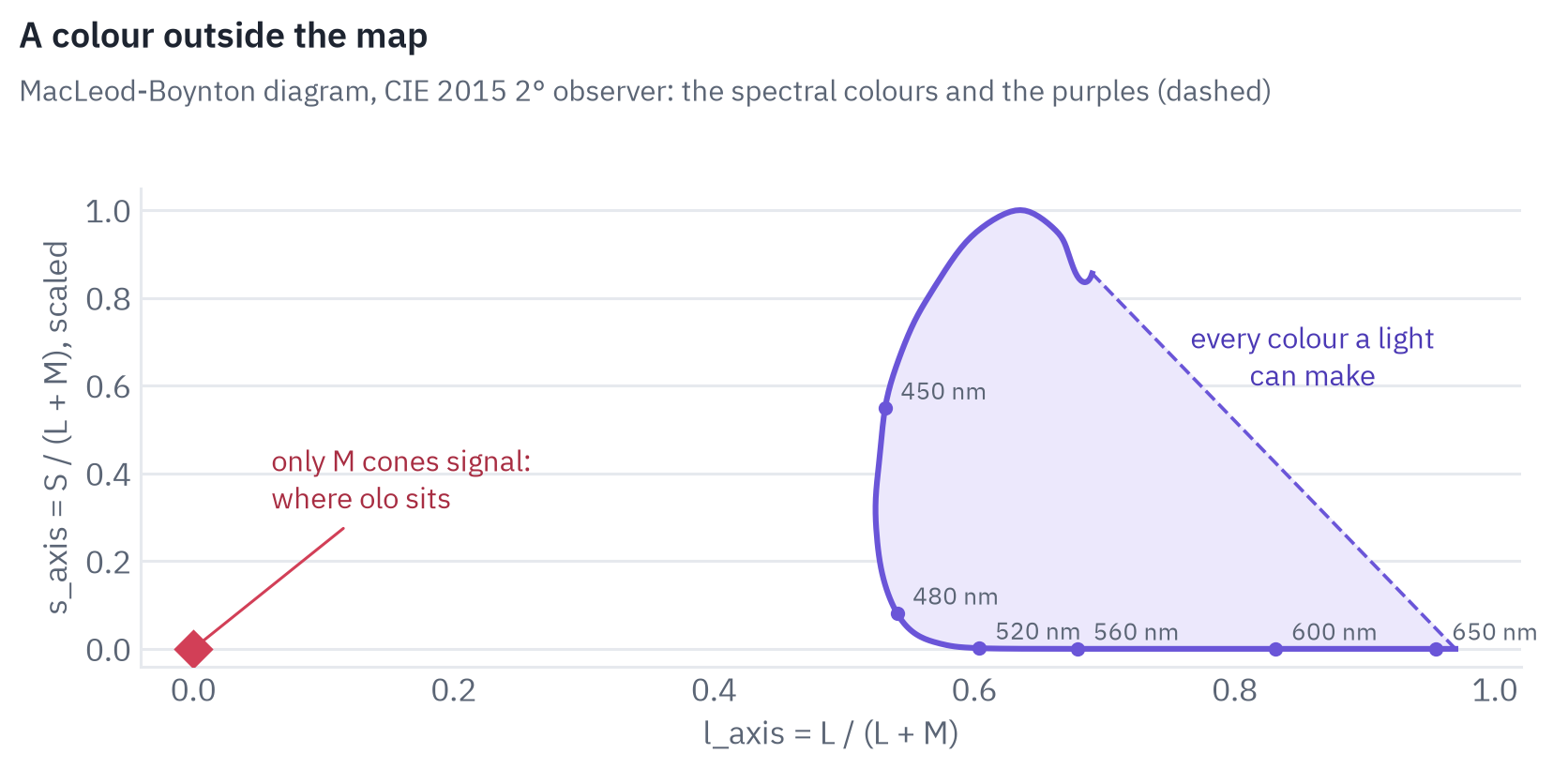
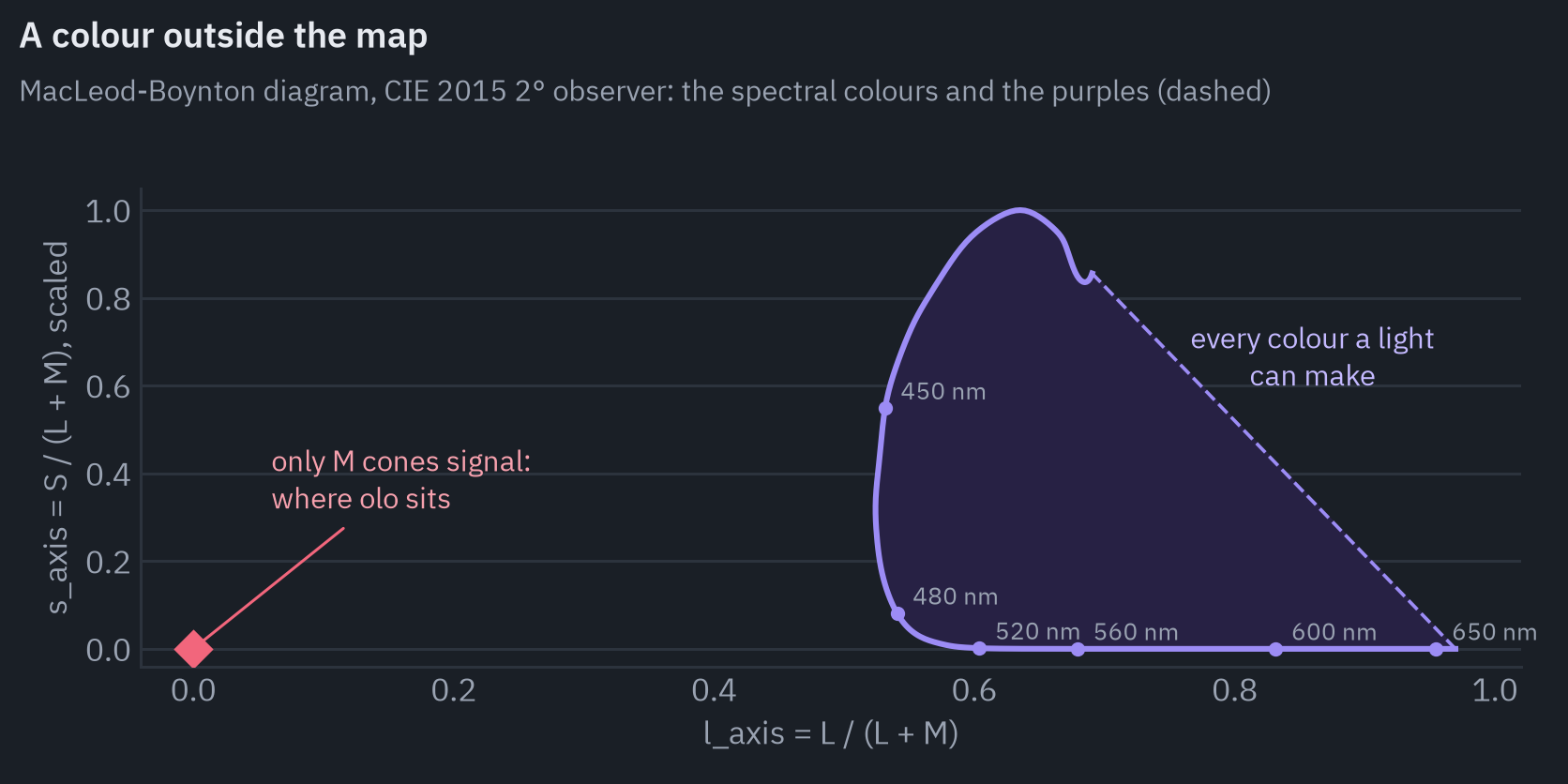
Olo is not a new hue but a saturation no light can produce; the authors call it “a partial expansion of colorspace.” Nobody could have imagined it in advance, and nobody did. It arrived through a new input.
There is even a hint that the input then extends imagination: after seeing “forbidden” colours such as reddish-green under special viewing conditions, “two subjects noted independently that reddish-green and yellowish-blue colors could now be imagined”[16], although whether such colours are really seen is disputed[17].
Image generators show the same boundary in their own way. They combine concepts they have learned, with what the DALL·E authors called “a rudimentary ability to compose unusual concepts”[18], and they render a concept well only if they saw it often: across models including Stable Diffusion, linear improvements on a concept took “exponentially more data” about it[19].
A genuinely new object can be taught to them from “only 3-5 images”[20]: a new input, again.
Generate, then select
In 1960 the psychologist Donald Campbell proposed that creative thought works like evolution: blind variation and selective retention, many candidates produced without foresight and a few kept[21].
Dean Keith Simonton has defended the theory for decades[22], others argue it does not fit how ideas actually develop[23], and after more than sixty years “without any resolution of the controversy”[24] the core distinction has stuck: producing candidates and choosing among them are different jobs.
The brain seems to split them between networks that usually work against each other. The default mode network is active when attention turns inward, to memories, plans and daydreams. The executive control network holds a goal and checks progress toward it.
The salience network decides which of the two the moment calls for. In creative thought, Roger Beaty and colleagues write, “the default and executive control networks, which can show an antagonistic relation, tend to cooperate”[25].
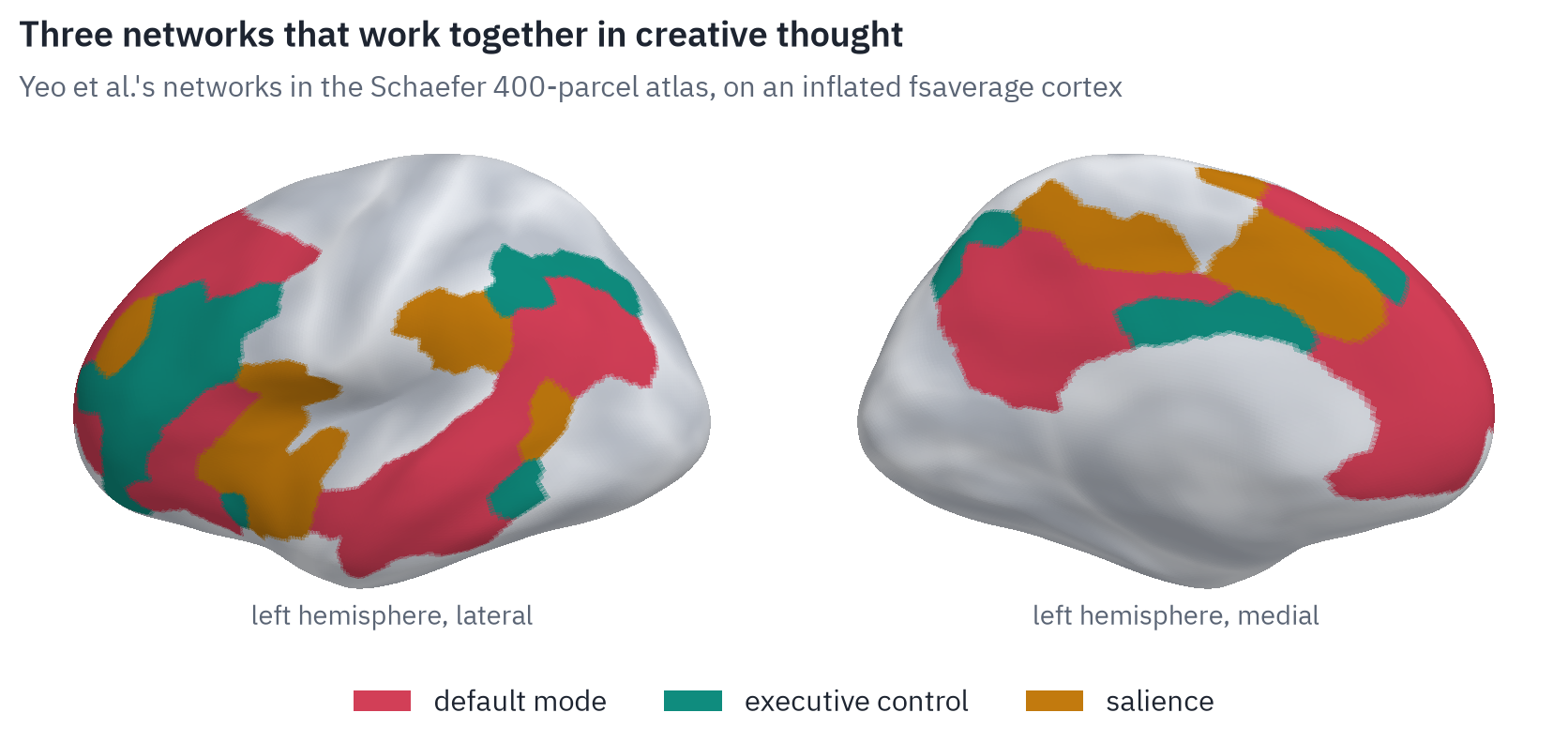
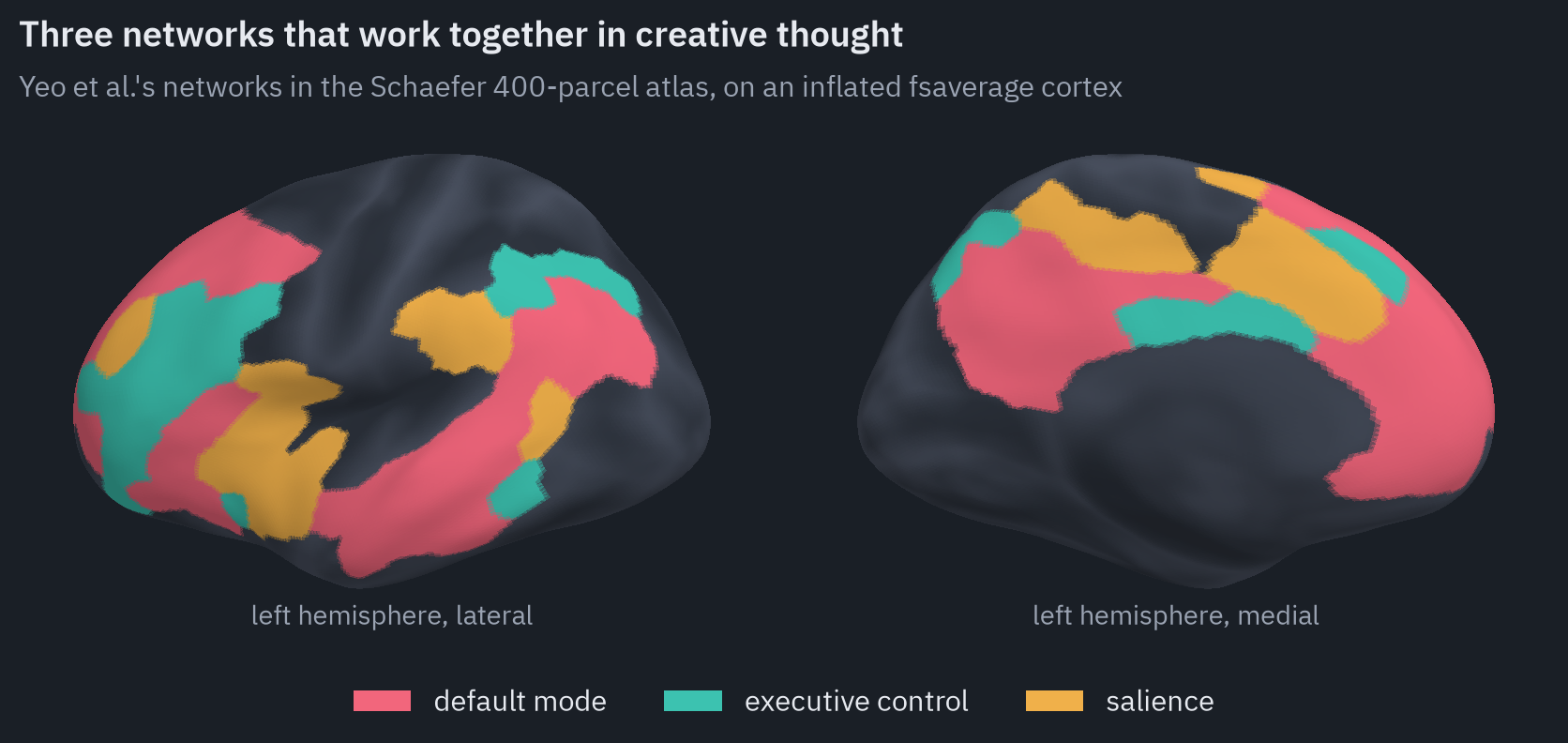
In 2018 the same group scanned 163 people while they thought of unusual uses for objects and found a pattern of connections among these three networks that predicted the originality of the ideas of people the model had not seen, with a correlation of 0.30[26].
It held in samples from Austria and China, at 0.35, 0.28 and 0.13. These are modest numbers: brain connectivity tells you something about a person’s creativity, not much.
The best-known finding about letting go is also less simple than its retellings. Charles Limb and Allen Braun scanned six jazz pianists improvising and playing memorized music.
Improvisation showed “extensive deactivation of dorsolateral prefrontal and lateral orbital regions with focal activation of the medial prefrontal (frontal polar) cortex”[27]: parts of the brain that monitor behaviour went quiet, a part linked to self-expression switched on.
Later studies found that the involvement of the dorsolateral prefrontal cortex depends on the task and on expertise[28]. Creativity is not switching control off; it is choosing when control applies.
Machines have the same two jobs. AlphaGo’s networks were trained first on games between strong human players, then by playing against themselves; a search over continuations decided which of the proposed moves was worth playing[29].
Move 37 was a move that, by AlphaGo’s own estimate, a human would almost never play, and that its search judged good.
A language model has the variation half built in, in its sampling, and the selection half only if somebody adds it. Here is a small language model asked eight times, at three temperatures, how else a brick can be used:
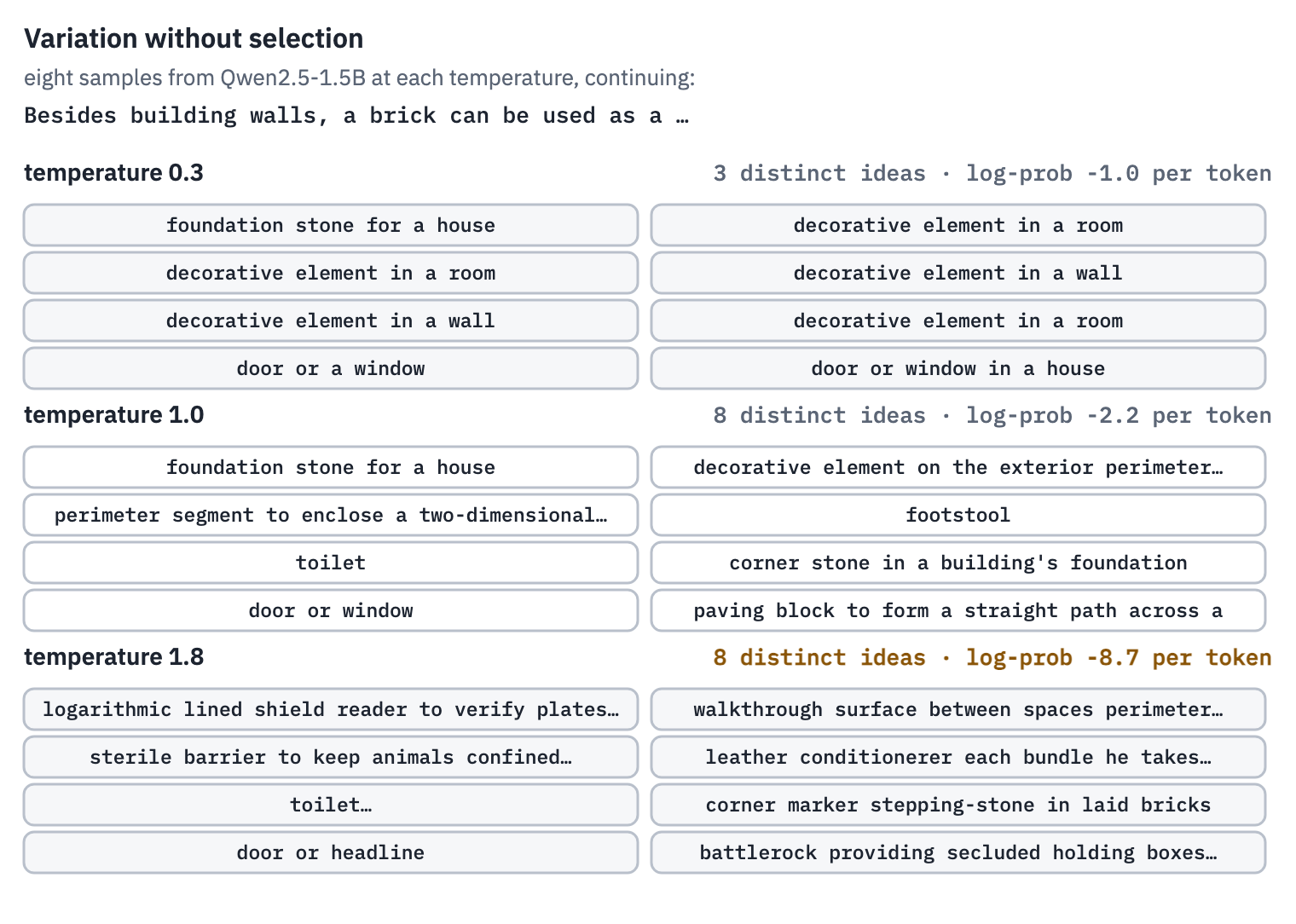
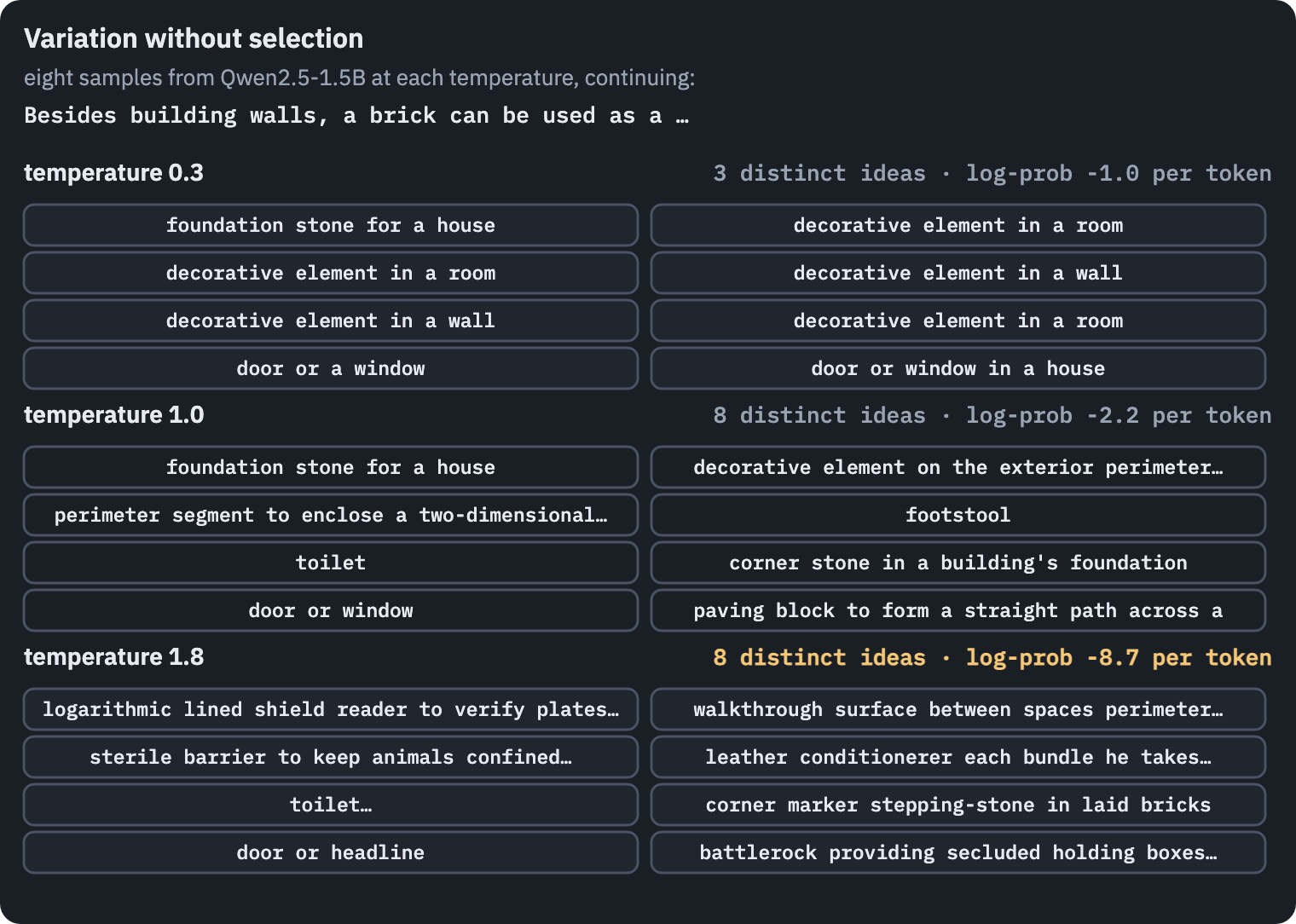
At a low temperature the model repeats one idea. At a medium one it produces eight different, sensible ones. At a high one it produces eight new ones, most of them broken, and the model itself rates them as very unlikely text.
Key point
Variation on its own is noise. Everything that makes it useful, a person choosing, a reward model trained on human preferences, a search that tries continuations, is selection.
Measuring machine creativity
Psychologists measure divergent thinking with tasks like the Alternate Uses Task: list unusual uses for a brick, a rope, a box. In 2023 Mika Koivisto and Simone Grassini gave it to 256 people and to three chatbots, ChatGPT-3.5, ChatGPT-4 and Copy.Ai, eleven sessions each, with four objects: rope, box, pencil and candle.
Six judges who did not know which answers came from machines rated every idea[30]. Their data are open, so here is every person and every session:
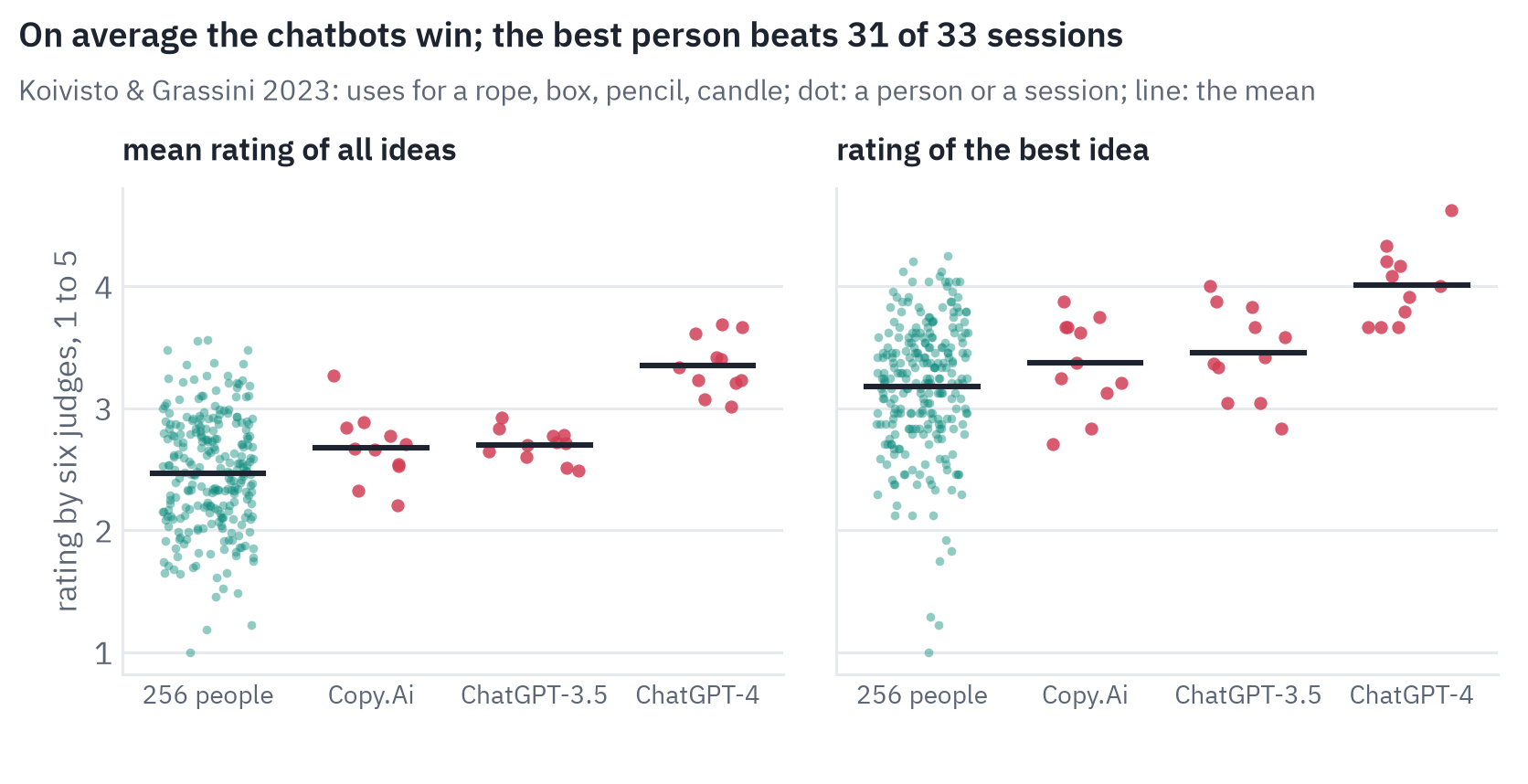
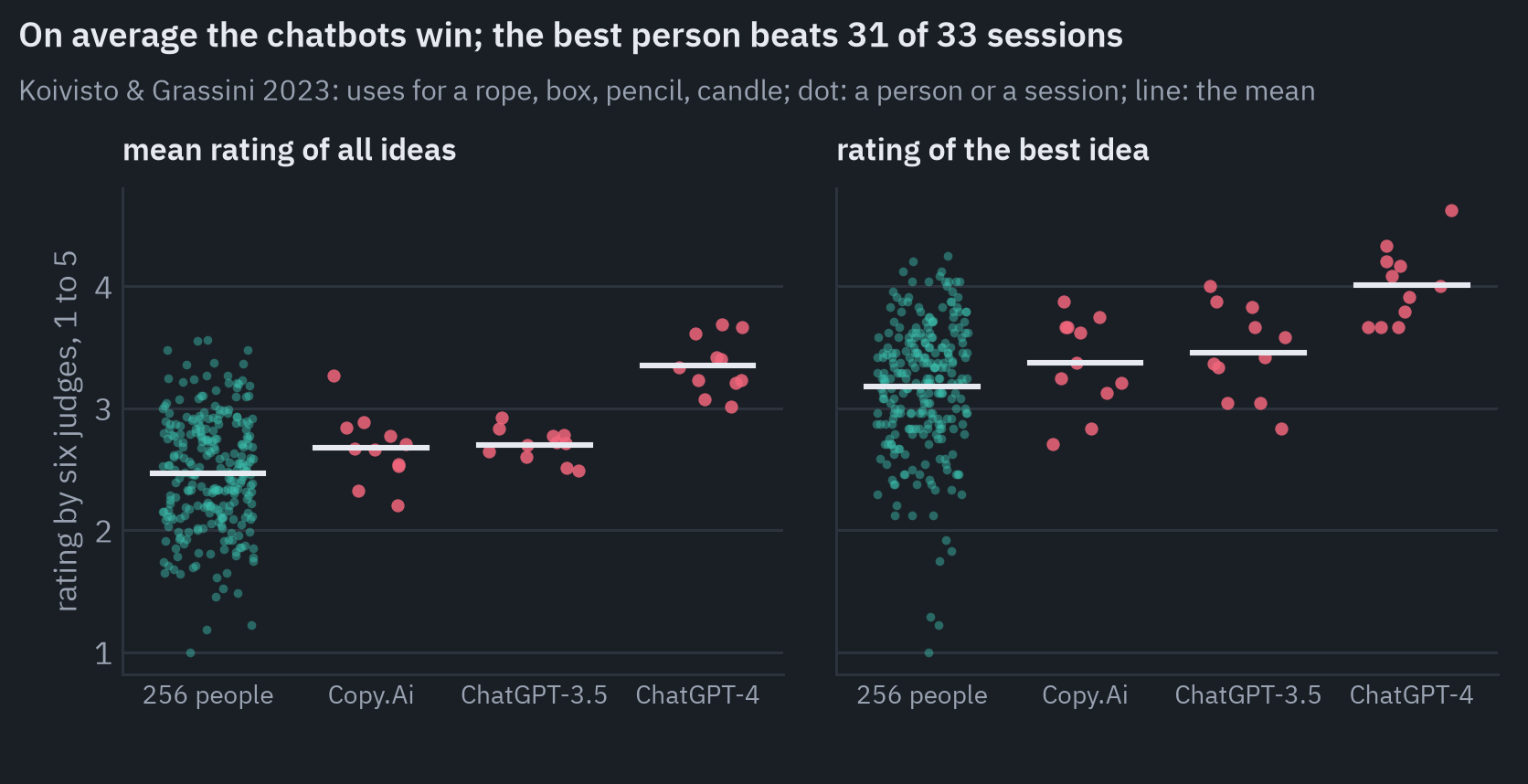
“On average, the AI chatbots outperformed human participants”, the authors write, and “the best human ideas still matched or exceed those of the chatbots”. Both are visible above. The people spread from the bottom of the scale to near the top.
The mean of 256 people sits below every chatbot, and only 7 people did better on average than ChatGPT-4, but the best person’s best idea beat 31 of the 33 chatbot sessions.
The authors add a caution about where the chatbots’ ideas come from: “It remains possible that they simply retrieve ideas that exist in their database.”
A larger study found GPT-4 “robustly more creative along each divergent thinking measurement” than 151 people, while noting that it scored originality automatically and did not measure usefulness at all, and that “creative potential is not a guarantee for creative achievement”[31].
What happens when people create with the machine? Anil Doshi and Oliver Hauser asked 293 people to write short stories, some with no help and some with story ideas from GPT-4, and had 600 readers rate them[32]:
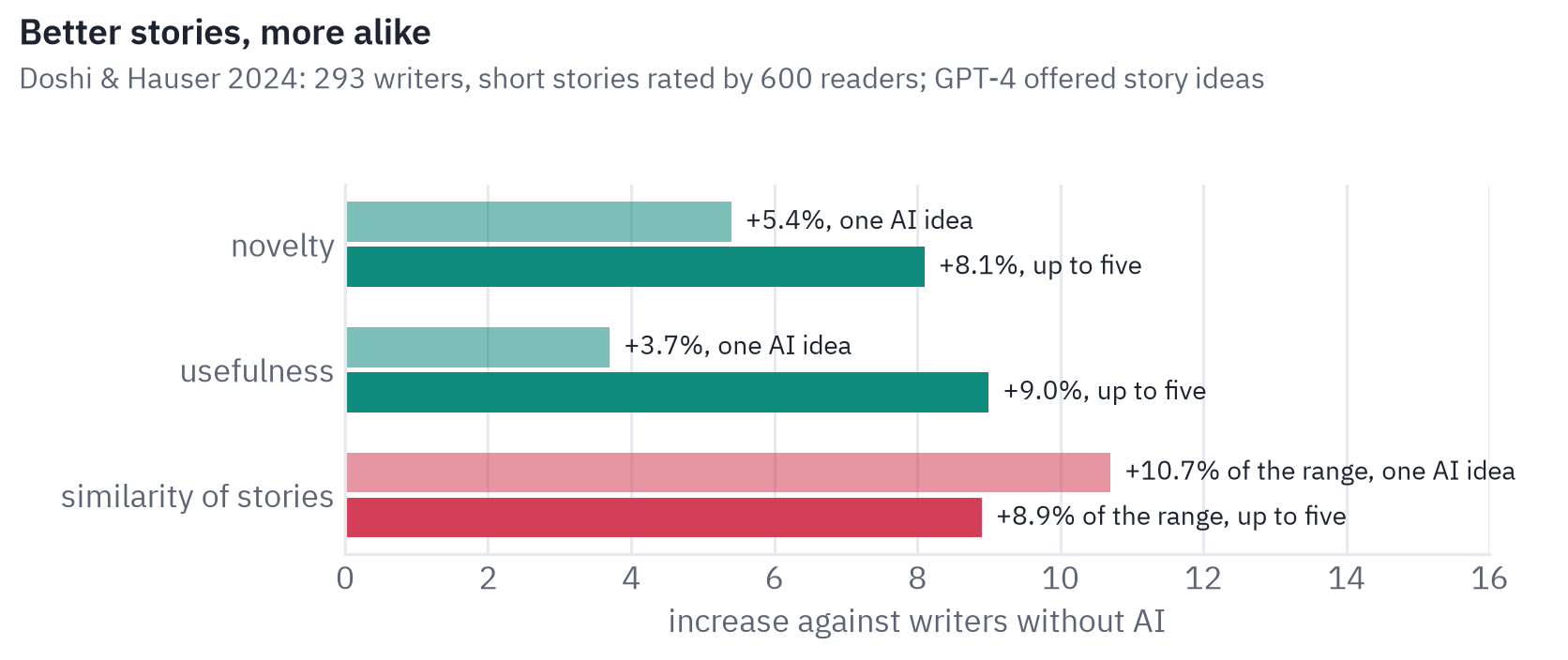
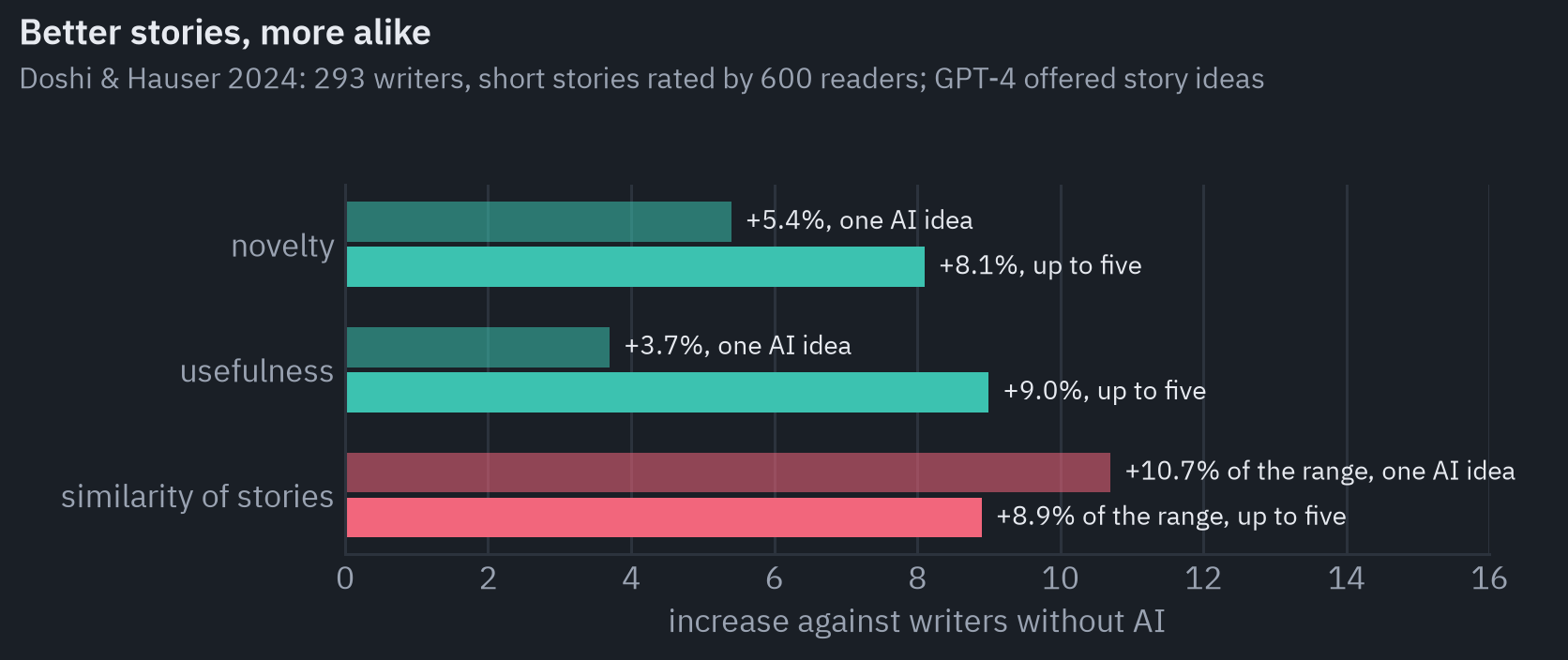
The stories written with AI ideas were judged more novel and more useful, especially those by the writers who were least creative on their own. They were also more similar to each other. “These results point to an increase in individual creativity at the risk of losing collective novelty.”
At the scale of a whole culture, the same pull toward the middle has a sharper version: models trained on the output of earlier models lose the rare cases first, “tails of the original content distribution disappear”[33], unless real data keeps being added[34].
Bodies and words
A common objection is that machines lack the bodily experience that grounds human ideas. Some of the evidence quoted for it is weaker than it sounds.
In a well-known study, reading the verbs “lick”, “pick” and “kick” activated areas along the motor strip next to those that move the tongue, fingers and feet[35].
That was fourteen people in a scanner; a later study found “no strong evidence for a somatotopic organisation of action word meaning representations”[36], and the activation can be explained without making it part of the meaning[37].
And words carry more of the world than the objection assumes. The blind adults above learned the structure of colour from talk.
GPT-4’s judgments of similarity between colours recover “the color wheel”, agreeing with human judgments at r = 0.79 when it is given only the colour words[38]; in another post I measured how much of the same structure sits inside a small open model.
What words cannot carry is olo. The difference between people and models here is not that one recombines and the other does not. It is in the inputs: a person’s stream of experience keeps bringing things no text describes.
Who does the selecting
If creativity is variation plus selection, the interesting question about AI art is who selects. In 2022 Jason Allen won the digital arts category of the Colorado State Fair with an image made in Midjourney, after about 80 hours and more than 900 renderings[39].
The US Copyright Office refused to register it as submitted because it “contains more than a de minimis amount of content generated by artificial intelligence”[40], although Allen had revised his prompts at least 624 times.
In 2025 a federal appeals court confirmed that copyright requires “all eligible work to be authored in the first instance by a human being”, while noting that this “does not prohibit copyrighting work that was made by or with the assistance of artificial intelligence”[41].
The Supreme Court declined to hear the case in March 2026. The law, in effect, puts the author where the selection is.
After move 37
Three days after move 37, in the fourth game, Lee Sedol played a move of his own, a wedge at move 78 that AlphaGo had also put at one in ten thousand[2].
Commentators called it the divine move. Analysis later showed it does not actually work; AlphaGo’s reply was the real mistake, and Lee won the game, the only one a human took from AlphaGo in that match.
Then something happened to the players. Minkyu Shin and colleagues analysed 5.8 million moves by professional Go players from 1950 to 2021. For 66 years the novelty of human play stayed flat.
After superhuman Go programs appeared, “novel decisions (i.e., previously unobserved moves) occurred more frequently and became associated with higher decision quality”[42]. The players were not copying the machines’ moves, the authors argue, or not only. They were searching a space that had turned out to be larger than they had thought.
References
- Metz, C. (2016). The sadness and beauty of watching Google’s AI play Go. Wired. ↩
- Hassabis, D. (2016). What we learned in Seoul with AlphaGo. Google. ↩
- DeepMind. AlphaGo. Google DeepMind research page. ↩
- Lovelace, A. A. (1843). Notes on the Sketch of the Analytical Engine by L. F. Menabrea. Scientific Memoirs, 3. ↩
- Turing, A. M. (1950). Computing machinery and intelligence. Mind, 59(236), 433–460. ↩
- Runco, M. A., & Jaeger, G. J. (2012). The standard definition of creativity. Creativity Research Journal, 24(1), 92–96. ↩
- Boden, M. A. (2007). Creativity in a nutshell. Think, 5(15), 83–96; from The Creative Mind (2nd ed., 2004). ↩
- Schacter, D. L., & Addis, D. R. (2007). The cognitive neuroscience of constructive memory. Philosophical Transactions of the Royal Society B, 362, 773–786. ↩
- Hassabis, D., Kumaran, D., Vann, S. D., & Maguire, E. A. (2007). Patients with hippocampal amnesia cannot imagine new experiences. PNAS, 104(5), 1726–1731. ↩
- Squire, L. R., et al. (2010). Role of the hippocampus in remembering the past and imagining the future. PNAS, 107(44), 19044–19048. ↩
- Race, E., Keane, M. M., & Verfaellie, M. (2011). Medial temporal lobe damage causes deficits in episodic memory and episodic future thinking not attributable to deficits in narrative construction. Journal of Neuroscience, 31(28), 10262–10269. ↩
- Ellamil, M., Dobson, C., Beeman, M., & Christoff, K. (2012). Evaluative and generative modes of thought during the creative process. NeuroImage, 59(2), 1783–1794. ↩
- Locke, J. (1690). An Essay Concerning Human Understanding, III.iv.11. ↩
- Kim, J. S., Aheimer, B., Montané Manrara, V., & Bedny, M. (2021). Shared understanding of color among sighted and blind adults. PNAS, 118(33), e2020192118. ↩
- Fong, J., et al. (2025). Novel color via stimulation of individual photoreceptors at population scale. Science Advances, 11(16), eadu1052. ↩
- Billock, V. A., Gleason, G. A., & Tsou, B. H. (2001). Perception of forbidden colors in retinally stabilized equiluminant images. JOSA A, 18(10), 2398–2403. ↩
- Hsieh, P.-J., & Tse, P. U. (2006). Illusory color mixing upon perceptual fading and filling-in does not result in ‘forbidden colors’. Vision Research, 46(14), 2251–2258. ↩
- Ramesh, A., et al. (2021). Zero-shot text-to-image generation. ICML. ↩
- Udandarao, V., et al. (2024). No “zero-shot” without exponential data: pretraining concept frequency determines multimodal model performance. arXiv:2404.04125. ↩
- Gal, R., et al. (2022). An image is worth one word: personalizing text-to-image generation using textual inversion. arXiv:2208.01618. ↩
- Campbell, D. T. (1960). Blind variation and selective retention in creative thought as in other knowledge processes. Psychological Review, 67(6), 380–400. ↩
- Simonton, D. K. (2011). Creativity and discovery as blind variation: Campbell’s (1960) BVSR model after the half-century mark. Review of General Psychology, 15(2), 158–174. ↩
- Gabora, L. (2011). An analysis of the blind variation and selective retention theory of creativity. Creativity Research Journal, 23(2), 155–165. ↩
- Simonton, D. K. (2013). Creative thought as blind variation and selective retention: why creativity is inversely related to sightedness. Journal of Theoretical and Philosophical Psychology, 33(4), 253–266. ↩
- Beaty, R. E., Benedek, M., Silvia, P. J., & Schacter, D. L. (2016). Creative cognition and brain network dynamics. Trends in Cognitive Sciences, 20(2), 87–95. ↩
- Beaty, R. E., et al. (2018). Robust prediction of individual creative ability from brain functional connectivity. PNAS, 115(5), 1087–1092. ↩
- Limb, C. J., & Braun, A. R. (2008). Neural substrates of spontaneous musical performance: an fMRI study of jazz improvisation. PLoS ONE, 3(2), e1679. ↩
- Pinho, A. L., Ullén, F., Castelo-Branco, M., Fransson, P., & de Manzano, Ö. (2016). Addressing a paradox: dual strategies for creative performance in introspective and extrospective networks. Cerebral Cortex, 26(7), 3052–3063. ↩
- Silver, D., et al. (2016). Mastering the game of Go with deep neural networks and tree search. Nature, 529, 484–489. ↩
- Koivisto, M., & Grassini, S. (2023). Best humans still outperform artificial intelligence in a creative divergent thinking task. Scientific Reports, 13, 13601. Data: OSF. ↩
- Hubert, K. F., Awa, K. N., & Zabelina, D. L. (2024). The current state of artificial intelligence generative language models is more creative than humans on divergent thinking tasks. Scientific Reports, 14, 3440. ↩
- Doshi, A. R., & Hauser, O. P. (2024). Generative AI enhances individual creativity but reduces the collective diversity of novel content. Science Advances, 10, eadn5290. ↩
- Shumailov, I., et al. (2024). AI models collapse when trained on recursively generated data. Nature, 631, 755–759. ↩
- Gerstgrasser, M., et al. (2024). Is model collapse inevitable? Breaking the curse of recursion by accumulating real and synthetic data. arXiv:2404.01413. ↩
- Hauk, O., Johnsrude, I., & Pulvermüller, F. (2004). Somatotopic representation of action words in human motor and premotor cortex. Neuron, 41(2), 301–307. ↩
- Postle, N., McMahon, K. L., Ashton, R., Meredith, M., & de Zubicaray, G. I. (2008). Action word meaning representations in cytoarchitectonically defined primary and premotor cortices. NeuroImage, 43(3), 634–644. ↩
- Mahon, B. Z., & Caramazza, A. (2008). A critical look at the embodied cognition hypothesis. Journal of Physiology–Paris, 102, 59–70. ↩
- Marjieh, R., et al. (2024). Large language models predict human sensory judgments across six modalities. Scientific Reports, 14, 21445. ↩
- Smithsonian, 2022. smithsonianmag.com. ↩
- U.S. Copyright Office Review Board (2023). Théâtre D’opéra Spatial. ↩
- Thaler v. Perlmutter, No. 23-5233 (D.C. Cir. 2025); certiorari denied, No. 25-449 (2026). ↩
- Shin, M., Kim, J., van Opheusden, B., & Griffiths, T. L. (2023). Superhuman artificial intelligence can improve human decision-making by increasing novelty. PNAS, 120(12), e2214840120. ↩
The figures, the temperature experiment and the data behind the charts: articles/creative_ai.
Reference and BibTeX
Koroleva, E. (2025, January 10). Can AI be creative?. Eva Koroleva's blog. https://blog.korolevalab.com/blog/2025/creative-ai/
@misc{koroleva2025creativeai,
  author       = {Koroleva, Eva},
  title        = {{Can AI be creative?}},
  year         = {2025},
  month        = jan,
  howpublished = {Eva Koroleva's blog},
  url          = {https://blog.korolevalab.com/blog/2025/creative-ai/}
}